¶ 🔥 Case Study: Stronger, Faster 3D Prints with Pro PCTG
With Helio Additive's assessment and enhancement tool, we achieved:
- 💪 +34% increase in tensile strength (22.37 MPa → 29.94 MPa) on tensile specimens
- ⚡ 31% faster print time (1h 55m → 1h 19m) on tensile specimens
- ⚡ 27% faster print time on functional parts (2h 39m → 1h 56m)
- 🧠 Critical insight: Conservative Pro PCTG profiles were limiting both speed and strength
No material changes. No hardware changes. Just smarter G-code enhanced for the best Pro PCTG performance.
¶ ⚡ Unlocking Pro PCTG’s Speed & Strength Potential
Pro PCTG is 3D-Fuel’s engineering-grade copolyester filament, designed for functional parts that need toughness, chemical resistance, and dimensional stability. It’s the go-to choice when PLA isn’t strong enough and PETG isn’t tough enough.
We wanted to test: Can we print Pro PCTG significantly faster while maintaining the strength and reliability it’s known for?
What we discovered: Conservative thermal profiles weren’t just limiting speed — they were limiting strength too.
¶ 🧪 What Did We Test?
We tested Pro PCTG using two different approaches:
- Using default Pro PCTG settings in Bambu Studio
- Using Helio-enhanced G-code optimized for Pro PCTG’s thermal properties
Two validation methods:
- Tensile specimens (ISO 527-2 1A, 50% scale) — Measured strength and print time, tested to failure in mechanical tester
- Sub250 rocket drone body — Validated speed gains on real-world usecase
Then we compared:
- Tensile strength (how strong the tensile test parts were)
- Print time (across both geometries)
¶ 🚀 Why a Drone Body?
The Sub250 rocket drone body represents a demanding real-world application:
Design requirements:
- 💪 Impact resistant — Survives crashes and hard landings
- 🌡️ Thermal stability — Handles motor heat and outdoor temperature swings
- ⚡ Fast production — Drone builders need quick turnaround for iterations
Challenging geometry:
- Curved aerodynamic surfaces
- Thin walls for weight savings
- Multiple mounting points for components
Why Pro PCTG?
- Superior toughness for crash resistance
- Better temperature stability than PLA
- Chemical resistance for outdoor use
- Dimensional stability for precise motor/component fitment
This tests Pro PCTG’s core strengths for functional aerospace applications.
¶ 📚 Key Terms Explained
¶ 🔗 Bonding
How well each printed layer sticks to the next one.
Poor bonding leads to weak parts. Good bonding happens when the new layer melts into the previous one while it’s still warm.
¶ 🔥 Thermal Quality Index (TQI)
A measure of how close print temperatures are to ideal bonding conditions.
Scale: -100 to +100
- +100 (Red): Too hot — risk of sagging, stringing
- 0 (Green): Optimal bonding temperature
- -100 (Blue): Too cold — weak layer adhesion
¶ 🧪 Tensile Strength (MPa)
How strong a part is when pulled apart.
Higher MPa = stronger print. Parts are tested in a mechanical tester until they break.
¶ 🕓 Print Time
Total time the printer takes to finish the job.
Faster is usually better, as long as it doesn’t hurt quality or strength.
¶ 🌡️ Thermal Assessment: Catching the Problem Before Printing
Assessment of both parts using default Pro PCTG settings revealed significant overcooling issues:
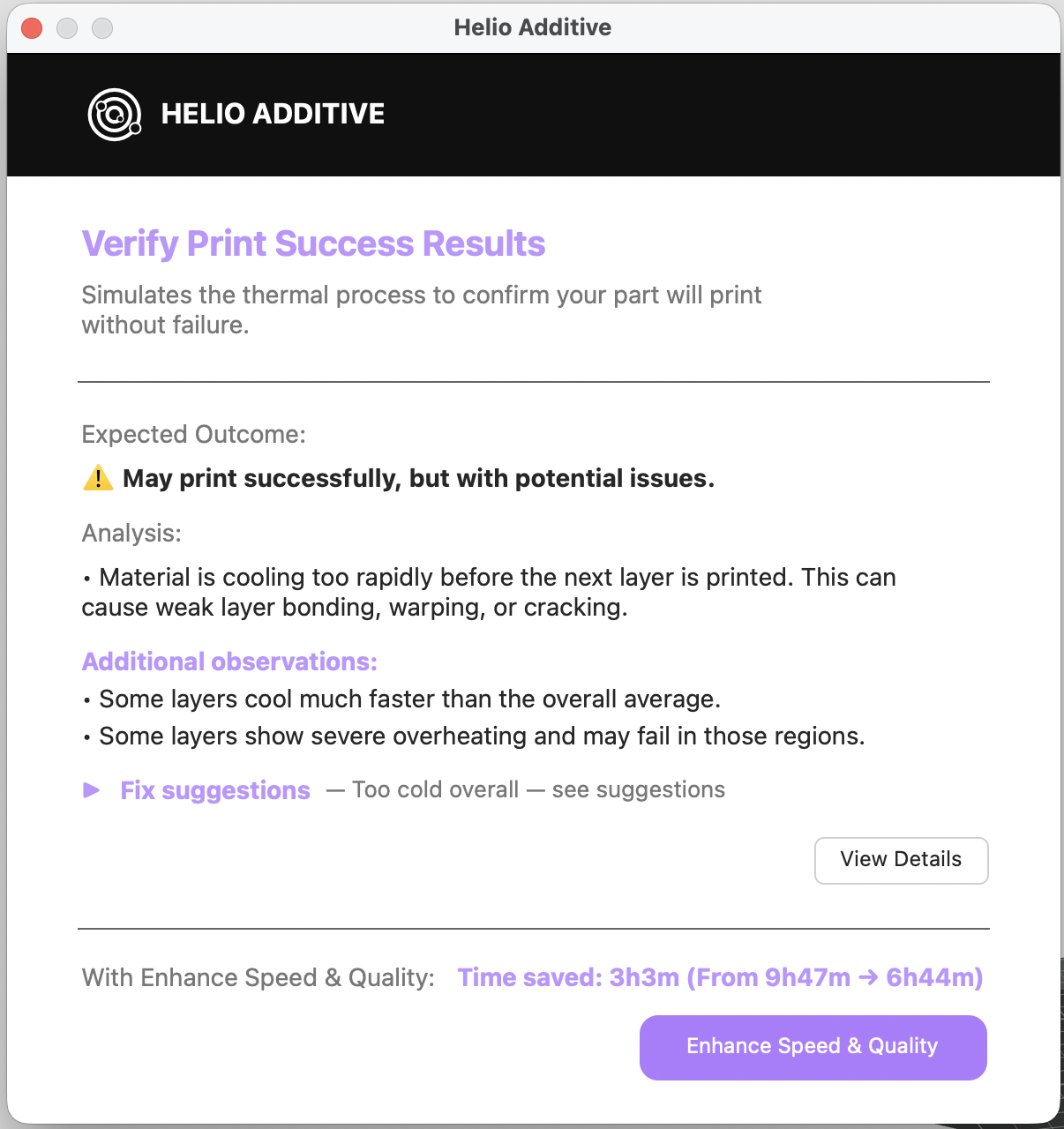
Assessment insights
What assessment revealed:
- Layers cooling too quickly (blue regions in TQI maps)
- Poor thermal conditions for layer bonding
- Part cooling fan causing heat loss
Recommended adjustments:
- Disable part cooling fan
- Increase chamber temperature to maximum recommended (55°C for Pro PCTG on H2D)
We followed the assessment recommendations, and ran enhancement with the print priority set to “Speed & Strength” for maximum speed and optimal bonding.
✅ Automatic fan speed adjustment is coming in March 2026
¶ 📊 Results Summary
| Metric | Default Settings | Helio Enhancement |
|---|---|---|
| Avg. Strength (Tensile Bars) | 22.37 MPa | 29.94 MPa (+34%) |
| Print Time (Tensile Bars) | 1h 55min | 1h 19min (-31%) |
| Print Time (Functional Part) | 2h 29min | 1 56min (-27%) |
🧠 The key insight: Pro PCTG profiles play it safe, leaving print speed and strength performance on the table. Helio tightens thermal control so you can run Pro PCTG hotter and more consistently, giving you stronger parts at faster speeds.
¶ 🕒 Print Time: Faster Across Geometries
Helio improved print time on both test geometries:
¶ Tensile Specimens (Small, Simple Geometry)
- Before: 1 hour 55 minutes
- After: 1 hour 19 minutes
✅ 31% reduction — 36 minutes saved
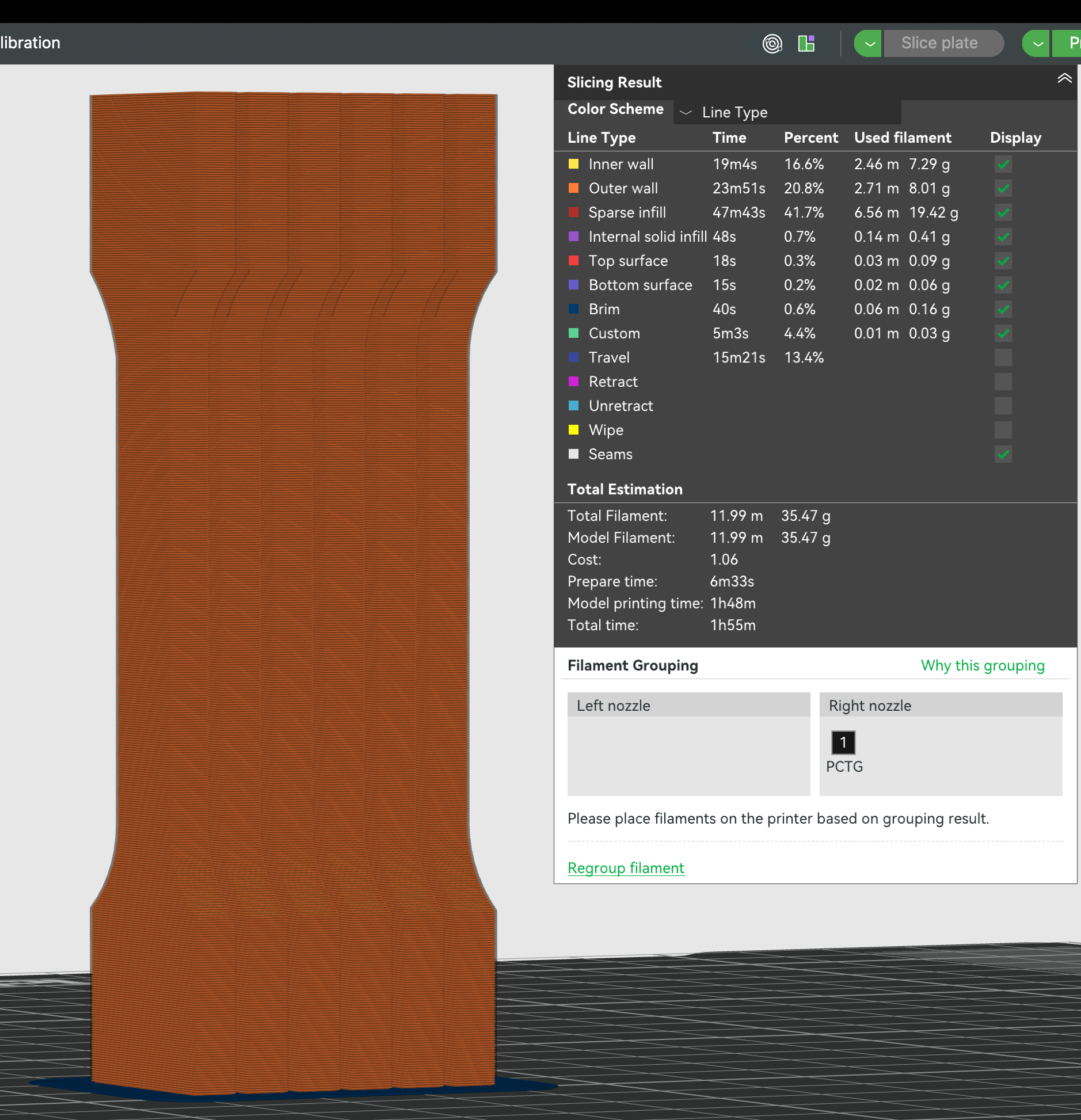
Original Print Time
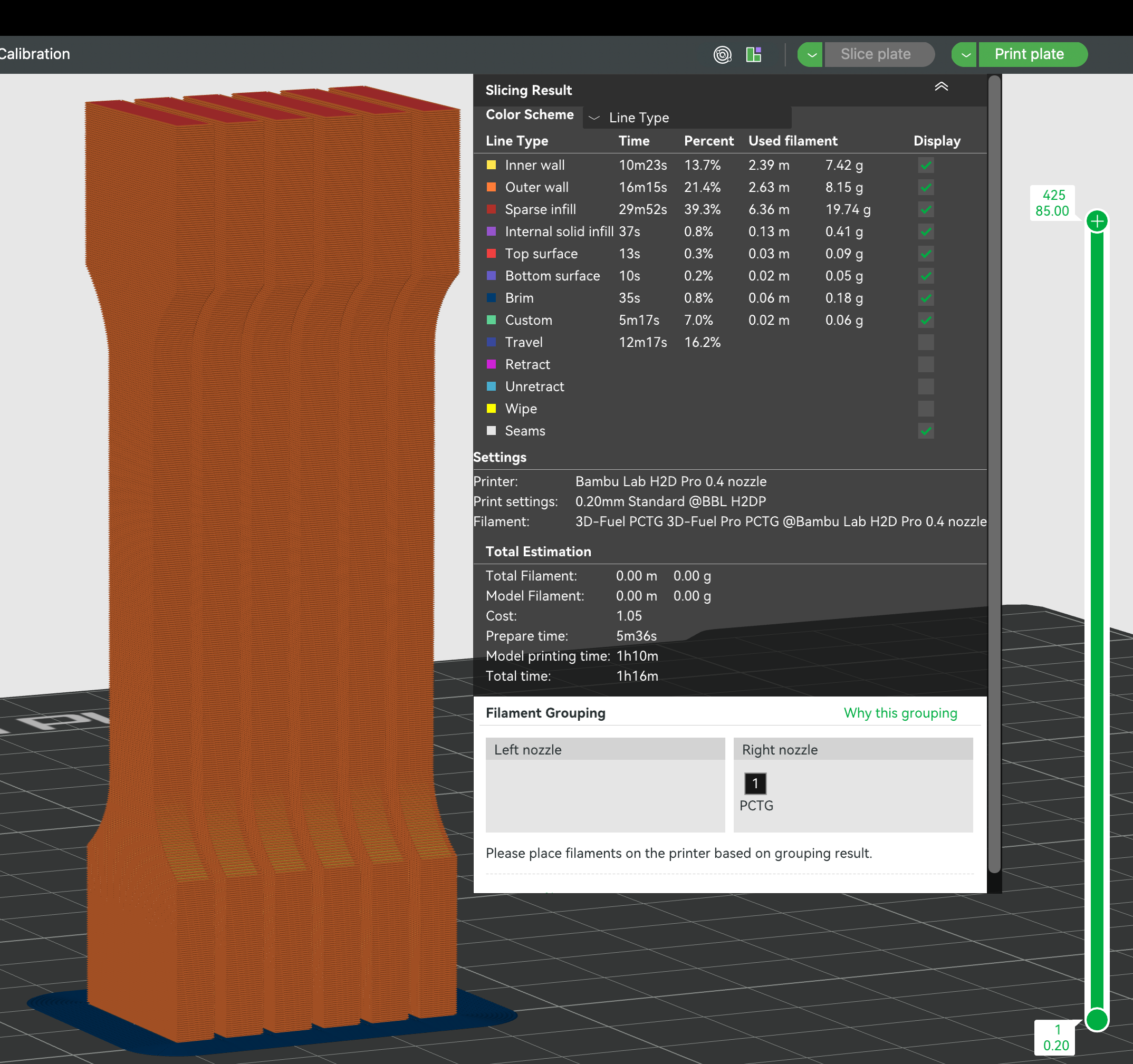
Enhanced Print Time
¶ Sub250 rocket drone body (Complex Functional Part)
- Before: 2 hours 39 minutes
- After: 1 hours 56 minutes
✅ 27% reduction — 43 mins
⚡ Time savings vary by geometry: Both simple and complex parts showed significant gains (27-31% faster).
¶ 🌡️ Thermal Quality Index
¶ Tensile Specimens
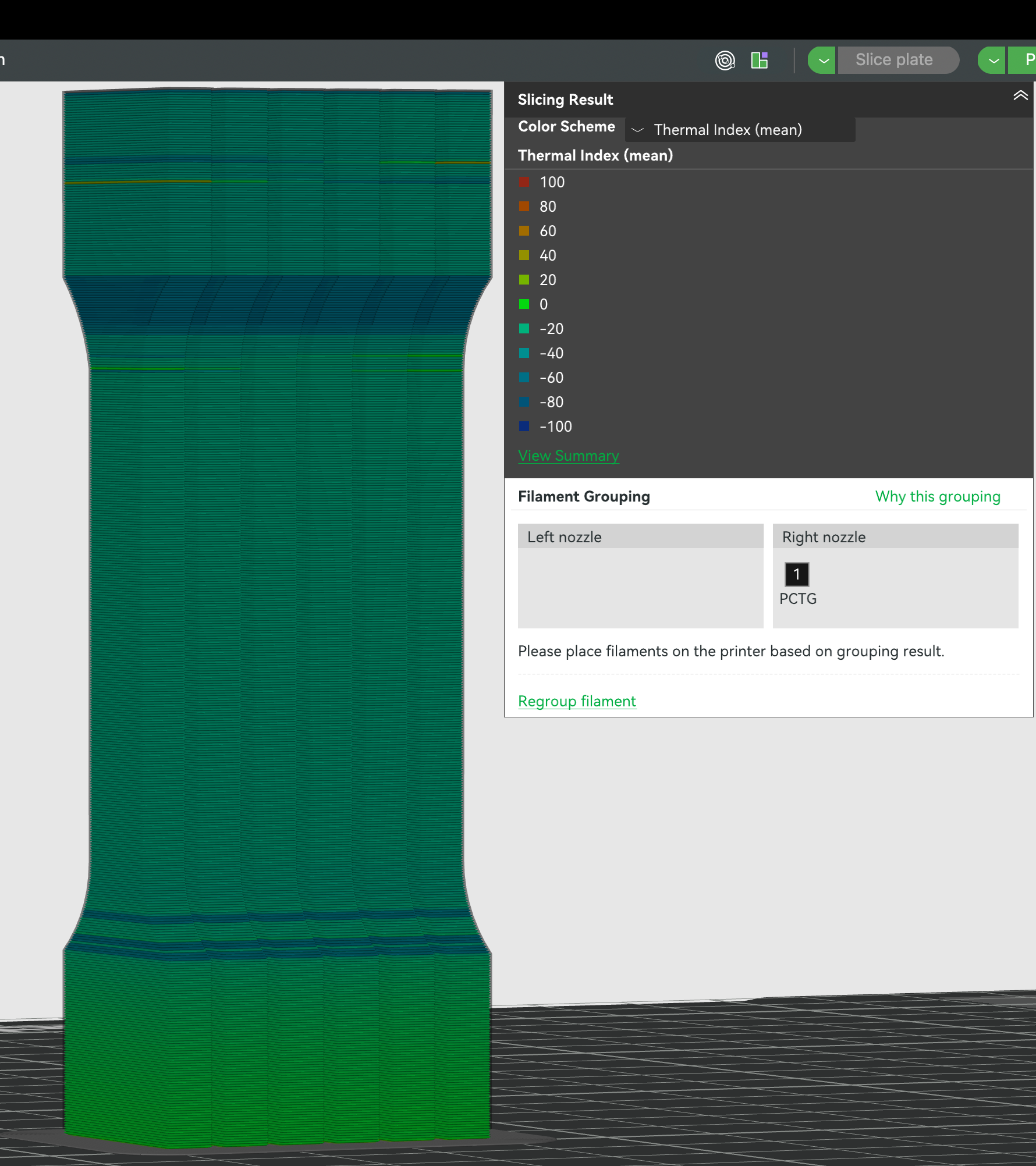
Original Thermal Quality Index
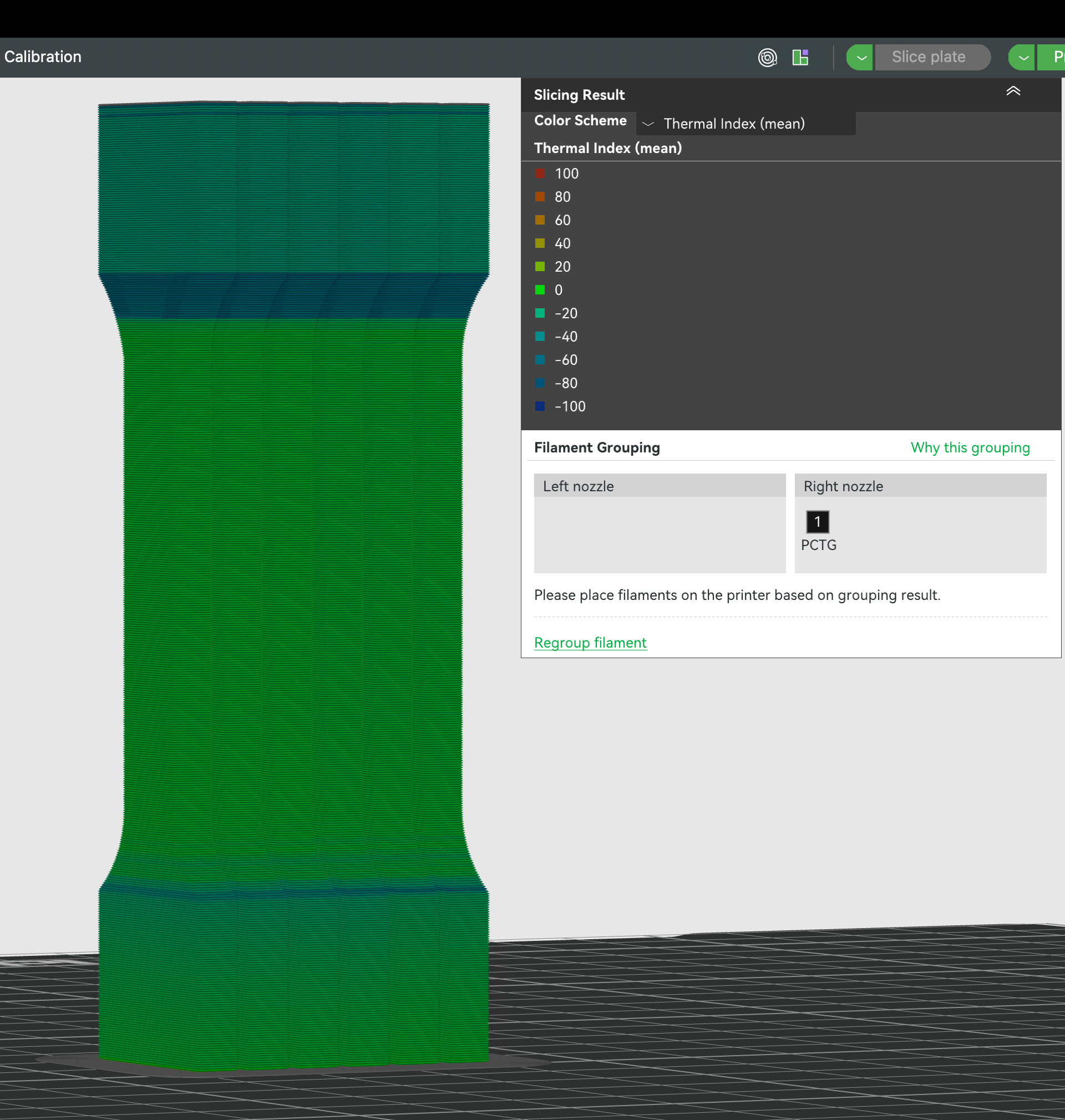
Thermal Quality Index After Enhancement
¶ Sub250 rocket drone body
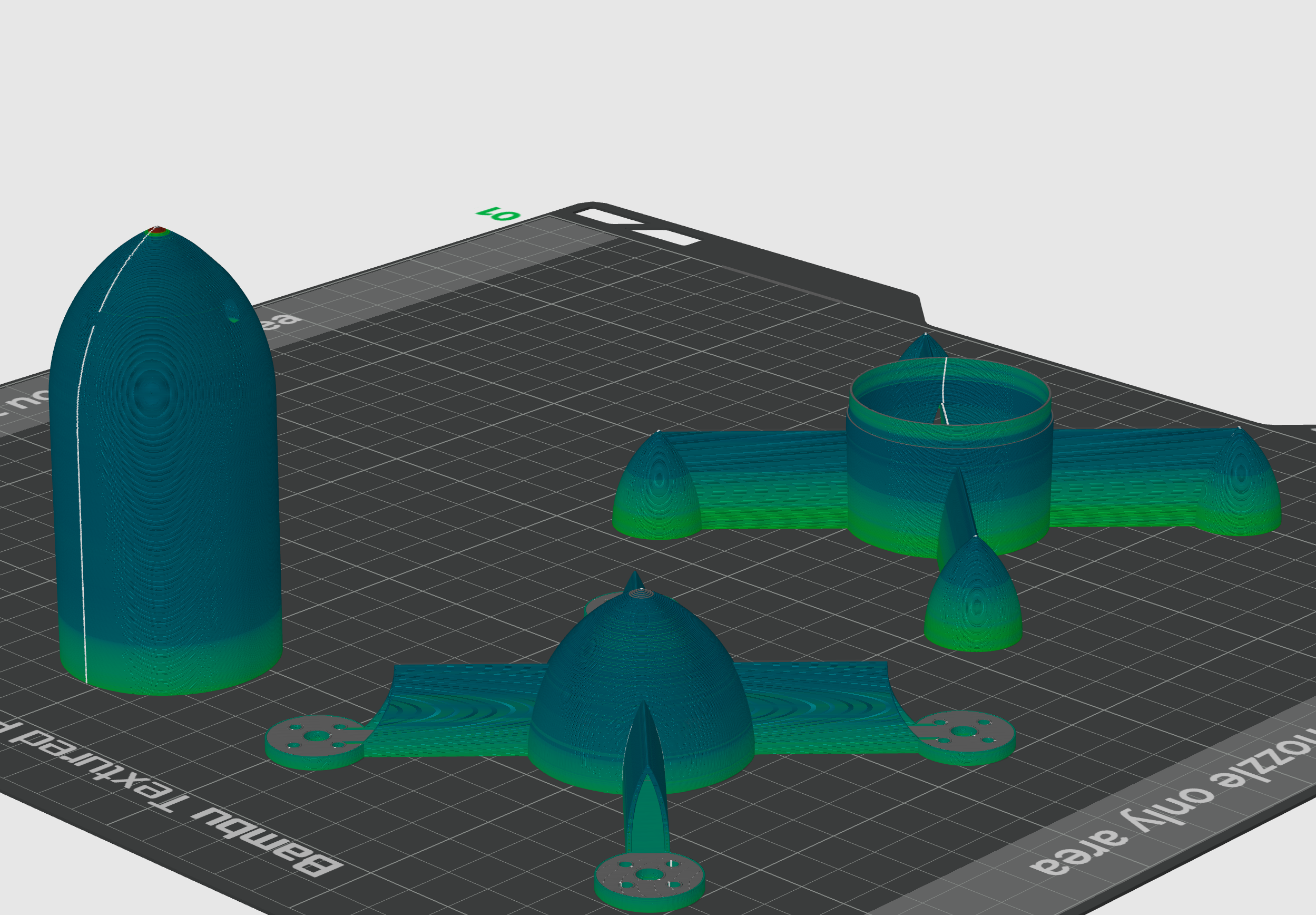
Original Thermal Quality Index
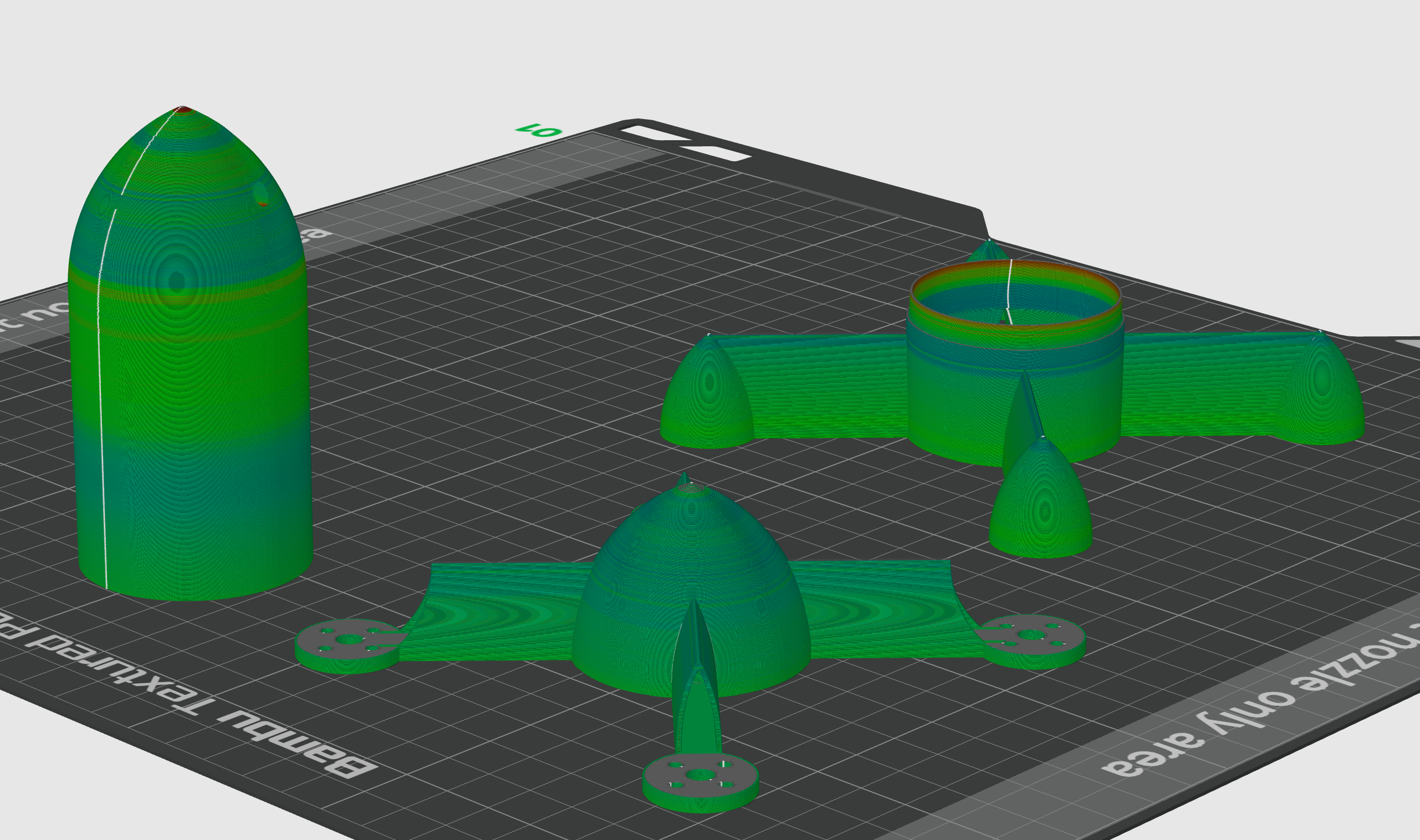
Thermal Quality Index After Enhancement
Before enhancement: Parts cooling too quickly (blue regions) causing poor layer bonding and weaker parts.
After Assessment+Enhancement: Optimal bonding temperatures maintained throughout (green regions) = better layer bonding = stronger parts.
¶ 💪 Why Strength Improved
Default Pro PCTG profiles cause overcooling:
- Layers cool too quickly between depositions
- Poor bonding between layers
- Parts weaker than the material’s actual potential
Helio’s thermal optimization:
- Maintained ideal bonding temperatures throughout the print
- Prevented premature cooling that weakens layer adhesion
- Optimized speeds to maximize both throughput and bonding quality
💪 The result: Parts that are up to 31% faster to print and 34% stronger — because Helio fixed the thermal issues that were limiting Pro PCTG’s performance.
¶ 🧠 Final Thoughts
Pro PCTG is already a powerful engineering material — tougher than PETG, more chemically resistant than PLA, more dimensionally stable than ABS. But Helio’s assessment revealed that conservative profiles were holding it back.
Default profiles designed to “play it safe” were actually causing overcooling, which limited both speed and strength. Printing slower wasn’t maximizing Pro PCTG’s strength potential.
With Helio Assess + Enhance, Pro PCTG becomes:
- 💪 Significantly stronger — 34% increase in tensile strength means higher load capacity and better safety margins
- ⚡ Much faster — 27-31% time savings (varies by geometry) means higher throughput and faster iterations
- 💰 More cost-effective — Print more parts, faster, and they’re actually stronger than before
Ideal for:
- Load-bearing brackets, fixtures, and mechanical assemblies
- Production runs where time savings multiply across batches
- Large functional parts (save 3+ hours on 10+ hour prints)
- Chemical-resistant applications (lab equipment, outdoor components, household items)
- Any application where Pro PCTG’s toughness and durability matter
💡 Conservative doesn’t always mean better. Sometimes “playing it safe” with thermal profiles means leaving performance on the table. Helio’s physics-based optimization unlocks what Pro PCTG was always capable of.
¶ 🧰 How to Try This Yourself
- Get the material — 3D-Fuel Pro PCTG
- Download profiles — Pro PCTG Print Profiles
- Install Helio — Helio Bambu Studio Plugin
- Assess your Pro PCTG G-code to identify thermal optimization opportunities & Enhance using Helio’s optimization — Download Beta release for latest features
- Print faster, stronger Pro PCTG parts
⚠️ Pro PCTG is hygroscopic — dry at 65-70°C for 4-6 hours before printing for best results.
¶ 📂 About the Partnership
This case study was enabled by the strategic partnership between Helio Additive and 3D-Fuel, which brought validated Pro PCTG material data into Helio’s physics-based simulation engine.
3D-Fuel is the first non-Bambu Lab, non-Polymaker FDM material available to customers in Helio’s library — demonstrating Helio’s commitment to supporting high-quality engineering materials.
Learn more about the partnership →
¶ 💬 Need Help?
- 📧 Helio Support: support@helioadditive.com
- 💬 Discord: discord.gg/helioadditive
- 📚 3D-Fuel: support.3dfuel.com
¶ 📂 Model Credit & Downloads
Original Design: Sub250 Rocket Drone by ASTDrones
💡 Interested in printing this drone? Download the original model from MakerWorld and use the Helio-enhanced Pro PCTG settings for faster, tougher results.
Print faster. Print stronger. Unlock Pro PCTG’s full potential with Helio.